
DOUBLE PLANETARY
MIXER
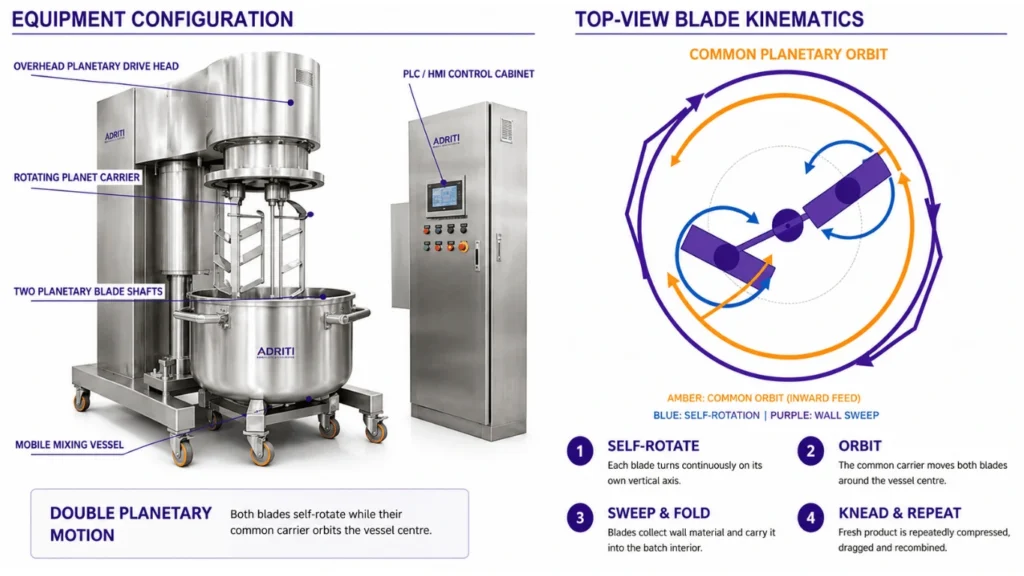
A vertical change-can mixer for viscous, sticky and paste-like products. Two identical blades rotate on their own axes while orbiting the vessel centre, continuously sweeping the walland bottom and folding material into the batch interior.
HOW THE MIXER WORKS

CHARGE
Load ingredients into the mobile stainless-steel vessel.


LOWER
Position the vessel and lower the planetary head.

SEAL
Close the cover and prove all safety interlocks.

MIX
Both blades self-rotate while orbiting the vessel centre.

RAISE
Stop, isolate and raise the drive head after verification.

DISCHARGE
Move the vessel for transfer, tilting or platen discharge.
APPLICATION FIT & PROCESS VALUE
RIGHT APPLICATION
Viscous pastes and gels
Suitable for sticky, cohesive or non-flowing formulations requiring positive blade contact.
Highly filled compounds
Planetary movement continually exposes fresh product to both blades
without relying on free flow.
Wet granulation
Rectangular or application-specific blades support controlled kneading and binder distribution.
DESIGN VALUE
Dual planetary motion
Each blade self-rotates while both blades orbit around the vessel centre.
Wall-to-centre transport
The blades sweep material from the wall and bottom and fold it into the interior.
Change-can productivity
Mobile vessels support charging, cleaning and discharge away from the mixer head.
CONSTRUCTION & CONFIGURATION OPTIONS
PRODUCT CONTACТ
SS304 or SS316L with application-specific internal finish and weld treatment
MIXER HEAD
Vertical lift head with enclosed planetary gearbox and two identical blade shafts
VESSEL
Mobile stainless-steel change-can with handles, casters and positive location system
DRIVE
High-torque VFD-controlled planetary drive with current and torque monitoring
CLEANING
Raised blade access and removable vessel support dry or validated wet cleaning
SAFETY
Vessel presence, head position, cover, zero-speed and lift interlocks with lockout provisions
SELF-ROTATION + ORBIT MIXING CONCЕРТ
Two identical blades rotate on their own vertical axes while their common carrier orbits the vessel centre. The blades continually sweep the wall and bottom, transporting material inward and repeatedly dividing, folding and recombining the batch.
CONTROLLED BATCH SEQUENCE
CHARGE
Load ingredients into the mobile vessel
LOWER
Locate vessel and lower the mixer head.
SEAL
Prove vessel, cover, lift and safety interlocks
MIX
Run self-rotation and orbital motion at validated speed.
RAISE
Stop, isolate and raise the head after verification.
DISCHARGE
Move the vessel to the selected discharge station.
CONTROL, SAFETY & MAINTENANCE
Start permissive
Mixer starts only with vessel located, head lowered and all guards proven.
Drive protection
Current, torque, speed and bearing monitoring detect overload or obstruction.
Motion control
VFD control maintains validated orbital speed, blade ratio and acceleration.
Safe access
Zero-speed proof and isolation are required before raising the head or handling blades.
Recipe control
Speed, blend time, spray sequence and discharge logic are stored by formulation.
Cleaning access
Raised blade access and removable mobile vessel support validated cleaning.
STANDARD RANGE & PRELIMINARY SIZING
Screening guide for paste, gel, putty-like and wet-granulation products. Working volume is shown as a planning range; final fill level, blade geometry,
orbit/self-rotation ratio, torque, lift, vessel and discharge must be validated for the formulation.
|
MODEL
|
WORKING VOLUME
|
GROSS VESSEL VOLUME
|
BATCH MASS AT 0.5 kg/L
|
TYPICAL FILL LEVEL
|
VESSEL EXECUTION
|
TYPICAL DUTY
|
|---|---|---|---|---|---|---|
|
PLM-25
|
10-18 L
|
25 L
|
5-9 kg
|
40-70%
|
Mobile can
|
Lab / pilot
|
|
PLM-50
|
20-35 L
|
50 L
|
10-18 kg
|
40-70%
|
Mobile can
|
Pilot/small batch
|
|
PLM-100
|
40-70 L
|
100 L
|
20-35 kg
|
40-70%
|
Mobile can
|
Production
|
|
PLM-250
|
100-175 L
|
250 L
|
50-88 kg
|
40-70%
|
Mobile can
|
Production
|
|
PLM-500
|
200-350 L
|
500 L
|
100-175 kg
|
40-70%
|
Mobile can
|
Heavy duty
|
|
PLM-1000
|
400-700 L
|
1,000 L
|
200-350 kg
|
40-70%
|
Mobile can
|
Heavy duty
|
PRELIMINARY SIZING BASIS
BATCH MASS
Mass = working volume x bulk density
Example: 1,000 L x 0.5 kg/L = 500 kg
Use loose bulk density at charging condition
CYCLE CAPACITY
Batches/h = 60/total cycle minutes
Include charge + blend + verify + discharge
Do not size from mixing time alone
WHAT CONTROLS THE FINAL SELECTION
Rheology
Initial and final viscosity, yield stress,
thixotropy, tack and temperature response.
Mix objective
Ingredient ratio, required homogeneity,
kneading duty and endpoint test.
Mechanical duty
Gross batch mass, starting torque, shaft
deflection, bearings and transmission load.
Blade selection
Rectangular or helical geometry, wall clearance and product release behaviour.
Process environment
Vacuum, heating, cooling, inerting, charging
and discharge requirements.
Hygienic duty
MOC, surface finish, gasket, vessel handling,
cleaning and validation standard.
FINAL ENGINEERING CHECK
Confirm rheology and batch data
Define endpoint and test
Complete representative trial
Verify peak torque and lift
Agree FAT acceptance criteria
Need the Right DOUBLE PLANETARY MIXER
for Your Process?
Our engineers will help you select, size and configure the ideal system for your application.
Download Product Brochure
Fill in your details below to download the brochure.