
BUCKET
ELEVATOR
A continuous positive-pressure conveying system in which filtered, conditioned air carries powder or granules in suspension. A blow-through rotary valve meters product from the source silo into the air stream for transfer to the receiving silo or process equipment.
HOW THE BUCKET ELEVATOR WORKS

FEED
Product enters the boot through a controlled inlet.


FILL
Buckets collect a consistent volume at the loading zone.

LIFT
The carrier moves loaded buckets through the enclosed trunk.

TURN
Buckets pass overnthe head pulley ornsprocket.n

DISCHARGE
Product exitsnthrough the topndischarge chute.

RETURN
Empty buckets circulate back to the boot.
BEST SUITED FOR
TYPICAL DUTIES
Vertical process transfer
Compact lifting where floor space is limited and elevation is required.
Gentle product handling
Low bucket speed and controlled filling can reduce product breakage.
Continuous line feeding
Stable transfer to silos, mixers, process vessels and packaging lines.
KEY ADVANTAGES
Enclosed construction
Dust-tight trunking helps protect product, operators and the surrounding area.
Flexible configuration
Bucket, carrier, inlet, discharge and construction are selected for the duty.
Automation ready
Speed, alignment, level and overload monitoring can be integrated with plant PLCs.
CONSTRUCTION & CONFIGURATION OPTIONS
CONTACT u041cu041eu0421
SS304, SS316L or application-specific material
BUCKET OPTIONS
Food-grade polymer, nylon or stainless steel
CARRIER
Belt or chain selected for load, temperature and hygiene
DISCHARGE
Single or multiple discharge arrangements
CLEANING
Clean-out doors, removable buckets or wash provision
INSTRUMENTATION
Zero-speed, misalignment, level and overload sensing
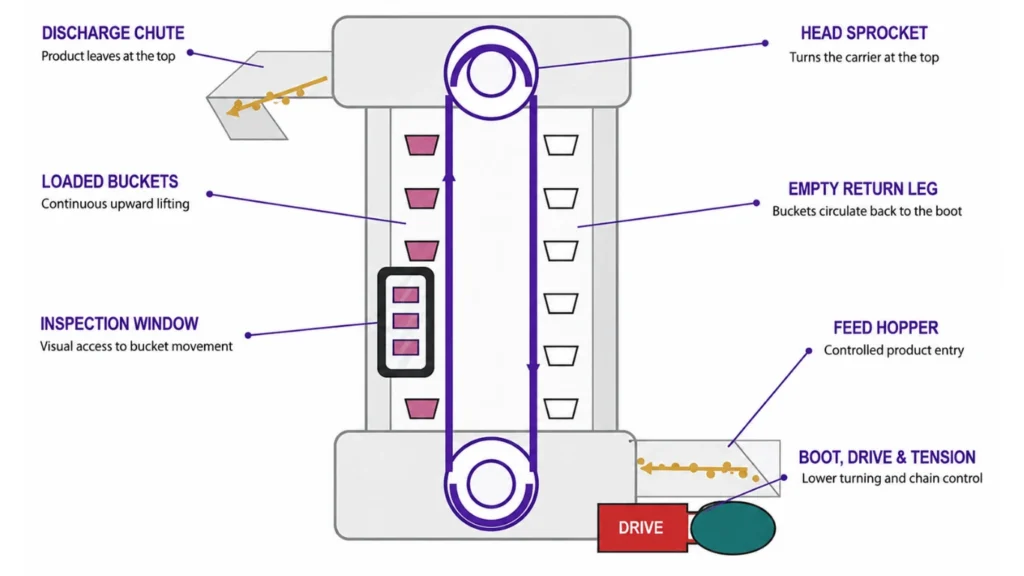
BUCKET ELEVATOR OPERATING CONCEPT
Material is fed into the lower boot, captured by moving buckets and lifted through a fully enclosed trunk. At the head, the buckets turnnand release product into the discharge chute before returning empty.n
CONTROLLED OPERATING SEQUENCE
FEED
Meter product into thenboot
FILL
Maintain consistent bucketnloading.
LIFT
Carry product upward innenclosure.
DISCHARGE
Release cleanly at thenhead
RETURN
Cycle empty buckets tonthe boot.
CONTROL, PROTECTION & MAINTENANCE
Feed interlock
The elevator starts before the upstream feeder and stops after the line clears.
Motion monitoring
Zero-speed and rotation feedback confirm that the carrier is moving.
Alignment protection
Belt or chain misalignment detection protects trunking and buckets.
Level & blockage
Boot and discharge level switches prevent overfilling and choking.
Drive protection
Motor overload, bearing-temperature and torque monitoring can be included.
Service access
Inspection windows, clean-out doors and guarded access support maintenance.
STANDARD CAPACITY & PRELIMINARY SIZING
Catalogue screening basis: free-flowing dry material at 0.5 kg/L bulk density, 75% nominal bucket fill, uniform feed and continuous duty. Values are
indicative and require application-specific verification.
|
MODEL
|
BUCKET WIDTH
|
BUCKET VOLUMu0415
|
PITCH
|
VOLUMETRIC CAPACITY
|
CAPACITY@ 0.5 kg/L
|
TYPICAL LIFT HEIGHT
|
|---|---|---|---|---|---|---|
|
BE-100
|
100 mm
|
0.4 L
|
200 mm
|
1.3-2.4 m3/h
|
0.7-1.2 t/h
|
2-6 m
|
|
BE-150
|
150 mm
|
1.0L
|
250 mm
|
3.2-5.4 m3/h
|
1.6-2.7 t/h
|
3-10 m
|
|
BE-250
|
250 mm
|
2.5 L
|
300 mm
|
7.9-13.5 m3/h
|
3.9-6.8 t/h
|
3-15 m
|
|
BE-400
|
400 mm
|
5.0 L
|
350 mm
|
7.5-13.5 t/h
|
4-18 m
|
15-27 m3/h
|
|
BE-650
|
650 mm
|
10 L
|
450 mm
|
27-45 m3/h
|
13.5-22.5 t/h
|
4-22 m
|
|
BE-1000
|
1000 mm
|
20 L
|
550 mm
|
44-78 m3/h
|
22-39 t/h
|
5-25 m
|
CAPACITY CALCULATION BASIS
VOLUMETRIC CAPACITY
Qv = 3.6 x Vb x (v / p) x eta
Qv in m3/h; Vb in litres; v and p in metres
MASS CAPACITY
Qm = Qv x rho /1000
Qm in t/h; rho is bulk density in kg/m3
AUTOMATION, CONTROL & SAFETY
Material behaviour
Flowability, fragility, abrasion, moisture,
temperature and dustiness.
Bucket & fill factor
Bucket geometry and actual usable fill determine carried volume.
Carrier speed & pitch
Speed and spacing balance capacity, discharge and product care.
Lift & discharge
Height, head geometry and downstream interface affect drive and release.
Inlet consistency
Controlled feeding prevents underfilling, overfilling and boot choking.
Hygiene & safety
Cleaning, guarding, earthing and hazard controls shape construction.
FINAL ENGINEERING CHECK
Confirm product andncapacity
Verify lift and interfaces
Select bucket and carrier
Calculate drive andntension
Approve trial/FAT criteria
Need the Right BUCKET ELEVATOR
for Your Process?
Our engineers will help you select, size and configure the ideal system for your application.
Download Product Brochure
Fill in your details below to download the brochure.