
BREATHER
VALVE
A breather valve protects storage tanks and process vessels against excessive internal pressure or vacuum during normal operation. It releases vapor when pressure rises and admits air when vacuum develops, then reseats automatically.
DUAL-ACTION TANK PROTECTION
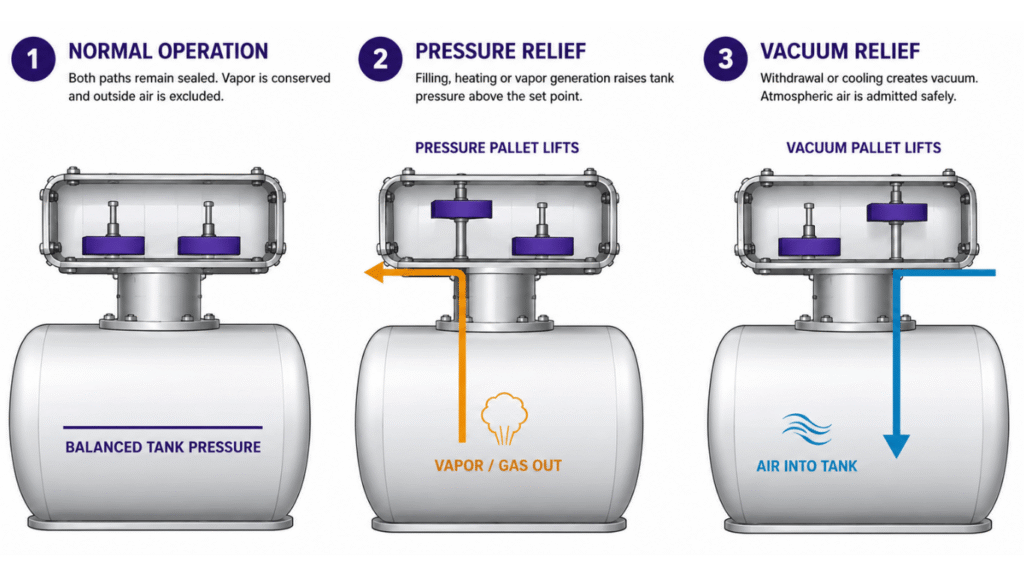
The calibrated pressure and vacuum pallets respond independently to changing tank conditions while remaining closed within the normal operating band.

NORMAL
Both pallets remain seated and help conserve vapor.


PRESSURE RISE
Filling, heating or vapor generation opens the pressure path.

VACUUM RELIEF
Withdrawal or cooling opens the atmospheric-air path.
PROCESS FIT & KEY VALUE
Dual protection
One assembly protects against both positive pressureand vacuum
Vapor conservation
Reliable sealing helps reduce avoidable product and vapor losses
Service access
Pallets, seats and sealing elements can be inspected and maintained.
Automatic operation
No external power or operator action is required for basic relief duty.
Industrial construction
Carbon-steel and stainless-steel options support varied services
Project-specific settings
Pressure and vacuum set points are selected from approved process data.
FEATURES & TECHNICAL RANGE
Pressure and vacuum protection
Independent calibrated opening paths protect the tank in both directions.
Reliable sealing
Seat and gasket selection supports vapor retention and service compatibility
Robust construction
Designed for storage tanks, process vessels and continuous outdoor service.
Simple maintenance
Accessible internal components support inspection, cleaning and replacement.
Adjustable set points
Weight- or spring-loaded designs are configured for the required settings.
Project compliance
Capacity and construction can be selected to applicable API/ISO / EN requirements.
TYPES OF BREATHER VALVES
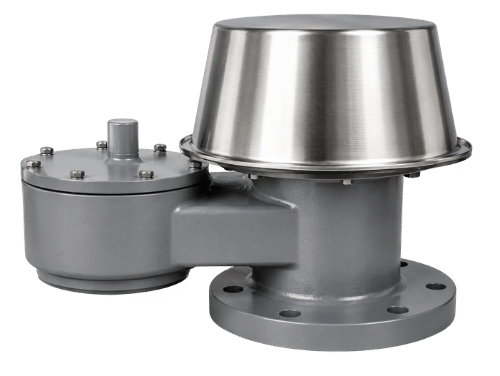
WEIGHT-LOADED BREATHER VALVE
Calibrated weights control pressure and vacuum opening. A simple, dependable and cost-effective solution for storage-tank breathing duty.
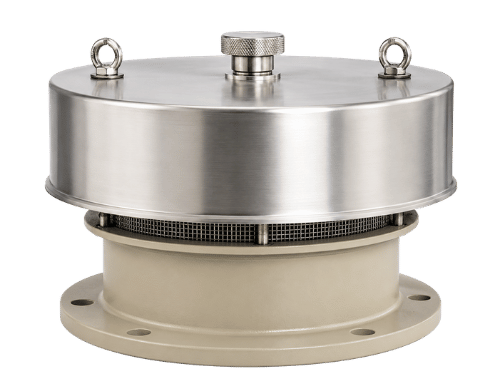
SPRING-LOADED BREATHER VALVE
Spring force controls opening at the selected pressure and vacuum set points where more precise control or compact packaging is required.
WORKING PRINCIPLE
TECHNICAL SPECIFICATIONS
|
|
|
|---|---|
|
Size range
|
1.5 in to 12 in
|
|
Set pressure
|
As per customer and tank-design requirement
|
|
Set vacuum
|
As per customer and tank-design requirement
|
|
Body material
|
Carbon steel or stainless steel
|
|
Sealing gasket
|
PTFE/Viton / EPDM
|
|
End connections
|
Flanged end or open-to-weld
|
|
Operating action
|
Weight loaded or spring loaded
|
TYPICAL APPLICATIONS
Storage tanks
Atmospheric and low-pressure tanks storing liquids that generate vapors.
Chemical process vessels
Tank breathing where controlled pressure and vacuum protection is required.
Petrochemical and oil & gas
Bulk storage installations requiring dependable vapor management.
Pharmaceutical storage
Material-compatible construction for sensitive processand storage duties
SELECTION & INSTALLATION GUIDANCE
SELECTION BASIS
– Maximum tank filling and emptying rates – Thermal inbreathing and outbreathing – Normal and design pressure /vacuum – Vapor properties and operating temperature – Required material and gasket compatibility Applicable capacity and design standard.
INSTALLATION NOTES
Install vertically on a clean, unobstructed tank nozzle – Confirm flow direction and required weather protection – Avoid undersized connecting nozzles and excessive pressure drop – Keep pallets, seats and vents free from deposits – Inspect after abnormal pressure or vacuum events – Verify settings and capacity before commissioning
Need the Right VERTICAL PRESSURE VESSEL
for Your Process?
Our engineers will help you select, size and configure the ideal system for your application.
Download Product Brochure
Fill in your details below to download the brochure.