
STAINLESS-STEEL
BELT CONVEYOR
A hygienic continuous conveyor for controlled transfer of bags, cartons, containers, components and selected process materials between production, inspection and packaging operations.
HOW THE SYSTEM WORKS

LOAD
Place products centrally on the belt.


DRIVE
The geared motor rotates the drive pulley.

CARRY
The upper belt strand transports product.

GUIDE
Adjustable rails maintain alignment.

DISCHARGE
Product transfers at the conveyor end.

RETURN
The unloaded belt returns underneath.
WHEN A FLAT BELT CONVEYOR IS THE RIGHT CHOICE
PROCESS FIT
Unit-load transfer
Ideal for bags, cartons, bottles, containers, trays and components.
Process integration
Connects filling, sealing, inspection, coding and packing stations.
Operator ergonomics
Reduces manual carrying and maintains a repeatable working height.
KEY ADVANTAGES
Smooth product flow
Continuous support helps protect stable product orientation.
Adjustable operation
Guide width, conveyor height and VFD speed can suit line requirements.
Automation ready
Sensors, stops, counters and downstream permissives can connect to the PLC.
CONSTRUCTION & CONFIGURATION OPTIONS
FRAME
SS304, SS316L or coated steel structure for the environment
BELT OPTIONS
PU, PVC, fabric, modular or application-specific belt surfaces
GUIDE SYSTEM
Adjustable stainless rails with polymer or stainless contact strips
CONFIGURATION
Horizontal, mild incline, mobile or integrated machine conveyor
CLEANING
Tool-free belt release, wipe-down or wash-compatible hygienic design
PROTECTION
Guards, emergency stop, tracking, overload and sensor interlocks
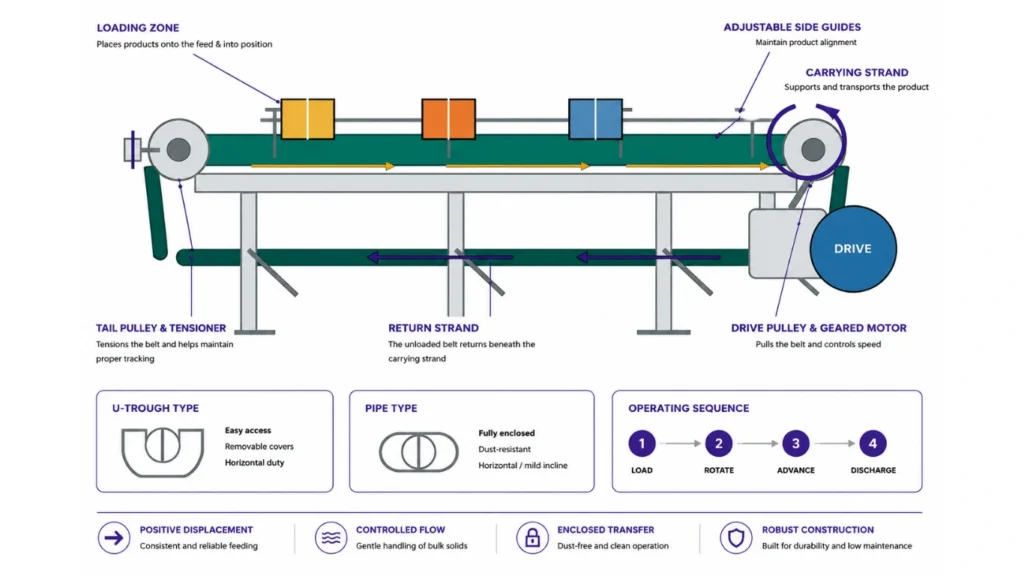
FLAT BELT CONVEYOR OPERATING CONCEPТ
A geared motor turns the drive pulley and pulls the endless belt around the conveyor. Products travel on the supported carrying strand, remain aligned by guides and transfer at the discharge while the empty belt returns below.
CONTROLLED OPERATING SEQUENCE
LOAD
Place product on the belt
DRIVE
Motor turns the drive pulley
CARRY
Upper strand moves product
GUIDE
Rails maintain alignment.
DISCHARGE
Transfer to the next stage
CONTROL, PROTECTION & MAINTENANCE
Start-up permissive
Confirm guards, downstream readiness and belt path before product infeed.
Load monitoring
Motor current and product sensors can identify overload or accumulation.
Tracking protection
Pulley alignment, guide setting and tracking sensors protect belt edges.
Discharge confirmation
Downstream equipment readiness is interlocked with conveyor operation.
Access protection
Inspection covers and drive guards are interlocked where required.
Cleaning access
Open-frame access and belt-release options support inspection and sanitation.
STANDARD RANGE & PRELIMINARY SIZING
Catalogue screening basis: horizontal continuous transfer of stable unit loads with non-accumulating operation. Product footprint, total live load, belt
friction, transfer gaps and sanitation requirements govern final selection.
|
MODEL
|
BELT WIDTH
|
LENGTH RANGE
|
SPEED RANGE
|
GUIDE TOTAL LIVE LOAD
|
MAX. PRODUCT WIDTH
|
TYPICAL USE
|
|---|---|---|---|---|---|---|
|
BC-200
|
200 mm
|
1-4 m
|
2-30 m/min
|
25 kg
|
150 mm
|
Small packs
|
|
BC-300
|
300 mm
|
1-6 m
|
2-30 m/min
|
40 kg
|
250 mm
|
Bottles/pouches
|
|
BC-400
|
400 mm
|
1-8 m
|
2-35 m/min
|
60 kq
|
350 mm
|
Cartons
|
|
BC-500
|
500 mm
|
1-10 m
|
2-35 m/min
|
80 kg
|
450 mm
|
Bags /trays
|
|
BC-600
|
600 mm
|
1-12 m
|
2-40 m/min
|
100 kg
|
550 mm
|
Large packs
|
|
BC-800
|
800 mm
|
1-12 m
|
2-40 m/min
|
150 kg
|
700 mm
|
Heavy unit loads
|
CAPACITY CALCULATION BASIS
BELT WIDTH GUIDE
Wbelt = Wproduct + side clearance
Allow typically 25-50 mm clearance on each side
UNIT THROUGHPUT
Units/min = belt speed x 1000 / pitch
Speed in m/min; product pitch in mm
WHAT CONTROLS THE FINAL SELECTION
Product geometry
Smallest base, largest footprint, height, weight and stability.
Belt selection
Friction, release, wear, food approval, ESD and chemical resistance.
Speed & drive
Throughput, accumulation, starting load, VFD
range and service factor.
Transfer geometry
Length, elevation, incline, pulley diameter and
end-to-end gap.
Guiding & controls
Guide clearance, orientation, sensors, stops,
counters and interlocks.
Cleaning & safety
Access, belt release, guarding, emergency
stops and wash-down duty.
FINAL ENGINEERING CHECK
Confirm product envelope
Approve conveyor layout
Select belt and guides
Calculate load, pull and drive
Agree trial/FAT criteria
Need the Right STAINLESS-STEEL BELT CONVEYOR
for Your Process?
Our engineers will help you select, size and configure the ideal system for your application.
Download Product Brochure
Fill in your details below to download the brochure.