
AUTOMATIC BAG
SLITTING MACHINE
A continuous, dust-controlled system for automatically feeding, opening and emptying small bags. The slitting unit opens each bag, while a rotating perforated drum recovers powder and discharges the empty sack separately.
HOW THE SYSTEM WORKS

FEED
Inclined conveyor meters bags to the inlet.


GUIDE
Rollers position the bag for cutting.

SLIT
Guarded cutters open the bag.

TUMBLE
Drum paddles release retained powder.

SEPARATE
Powder falls through the perforations.

DISCHARGE
Empty sacks exit to a collection trolley.
APPLICATION FIT & KEY ADVANTAGES
RIGHT APPLICATION
High bag frequency
Suited to continuous production where manual opening creates a labour
bottleneck.
Multiple bag types
Can be engineered for paper, PE-lined paper and woven polymer sacks.
Powder applications
Supports minerals, chemicals, food ingredients and other dry bulk materials.
DESIGN VALUE
Reduced manual effort
Operators load the conveyor while cutting, emptying and sack discharge are automated.
Contained operation
Enclosed processing and extraction reduce airborne dust at the opening point.
Low product residue
Rotating drum and lifting paddles recover powder retained in folds and corners.
CONSTRUCTION & CONFIGURATION OPTIONS
CONSTRUCTION
SS304 or SS316L product-contact construction and modular support frame
BAG FEED
Fixed or variable-speed inclined conveyor with quides and inlet detection
OPENING
Roller guide and replaceable guarded cutter arrangement for selected bag tyре
SCREENING
Perforated rotary drum with internal lifters and application-specific openings
DUST CONTROL
Integral cartridge collector or connection to a central de-dusting system
EMPTY BAGS
Collection trolley, sack compactor or connection to waste-handling equipment
AUTOMATIC BAG EMPTYING OPERATING CONCEPТ
Bags are conveyed to a guarded cutter and transferred into a rotating perforated drum. Internal lifters tumble the opened sacks, powder falls into the hopper, airborne fines are filtered, and empty bags leave through a separate chute.
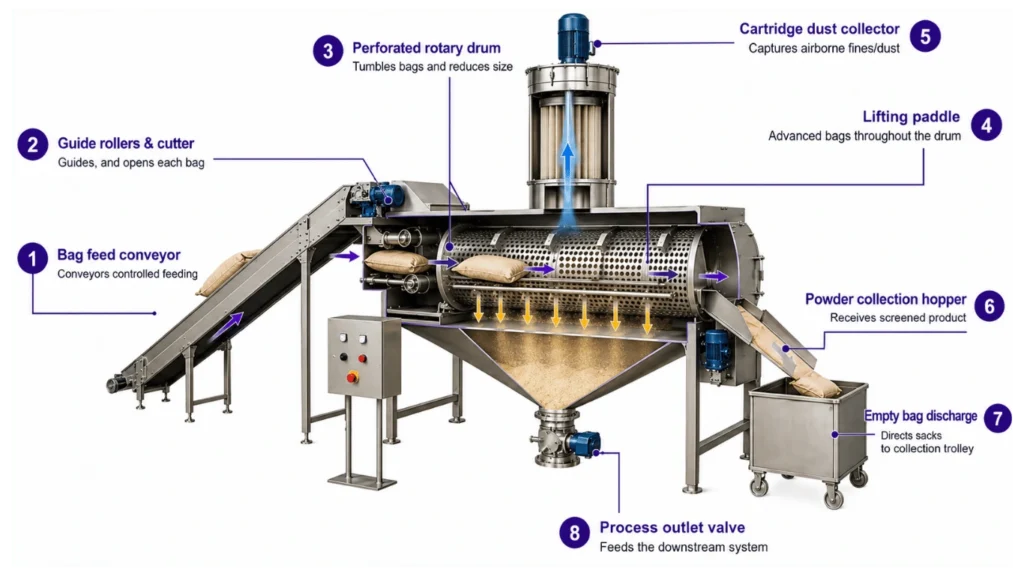
CONTROLLED OPERATING SEQUENCE
FEED
Move bags to the inlet.
SLIT
Guide and open each bag
TUMBLE
Release retained powder.
SEPARATE
Collect product below.
FILTER
Capture airborne fines.
DISCHARGE
Collect empty sacks.
CONTROL, SAFETY & MAINTENANCE
Feed permissive
Conveyor operates only when cutter, drum, extraction and outlet are available.
Guarded cutting
Access doors and covers are interlocked before the cutting mechanism can run.
Drum monitoring
Drive overload and speed confirmation protect the rotating screen assembly.
Dust monitoring
Filter differential pressure and extraction status support contained operation.
Jam protection
Torque or current monitoring stops feed before bags accumulate in the machine.
Cleaning access
Circular end door and removable panels provide access to cutter, drum and hopper.
STANDARD RANGE & PRELIMINARY SELECTION
Screening guide for conventional dry powders and 20-50 kg sacks. Final bag rate depends on bag construction, cutting response, product release, drum residence time, extraction and downstream acceptance rate.
|
MODEL
|
BAG WEIGHT
|
INDICATIVE BAG RATE
|
THEORETICAL MASS RATE*
|
DRUM CLASS
|
EMPTY-BAG HANDLING
|
EXTRACTION
|
|---|---|---|---|---|---|---|
|
ABS-300
|
20-50 kg
|
Up to 300/h
|
6-15 t/h
|
Compact
|
Trolley
|
Plant/ integral
|
|
ABS-450
|
20-50 kg
|
Up to 450/h
|
9-22.5 t/h
|
Standard
|
Trolley/compactor
|
Plant/ integral
|
|
ABS-600
|
20-50 kg
|
Up to 600/h
|
12-30 t/h
|
Heavy duty
|
Compactor
|
Plant/integral
|
|
ABS-C
|
Application
|
Custom
|
Custom
|
Custom
|
Custom
|
Custom
|
PRELIMINARY CAPACITY BASIS
THEORETICAL MASS RATE
Capacity = bags/hour x net bag mass
Divide by 1000 for tonnes/hour
Confirm actual emptying efficiency by trial
HOPPER SURGE CHECK
V>= mass between discharges / density
Apply operating and retained-volume allowance
Coordinate with the downstream feed device
WHAT CONTROLS THE FINAL SELECTION
Bag construction
Paper, liner, weave, thickness, seams, dimensions and bag condition.
Product behaviour
Bulk density, flowability, particle size, moisture and tendency to adhere.
Opening performance
Guide pressure, cutter geometry, bag orientation and feed spacing.
Drum duty
Diameter, length, speed, perforation, lifting paddles and residence time.
Dust control
Dustiness, toxicity, opening leakage, filter media, area and fan pressure.
Downstream route
Hopper surge, outlet device, interlocks and empty-bag handling method.
FINAL ENGINEERING CHECK
Test representative bags
Confirm powder and SDS
Approve cutter and drum duty
Establish extraction basis
Agree FAT performance criteria
Need the Right AUTOMATIC BAG SLITTING MACHINE
for Your Process?
Our engineers will help you select, size and configure the ideal system for your application.
Download Product Brochure
Fill in your details below to download the brochure.