
JACKETED TANK
& REACTION VESSEL
A stainless-steel batch vessel combining agitation with a
secondary heating or cooling jacket. It supports controlled charging, circulation, temperature ramping, reaction or hold time, endpoint verification and drainable discharge for compatible process duties.
HOW THE JACKETED VESSEL WORKS

CHARGE
Add liquids and Ingredients under the approved order and vessel conditions.


START
Prove level and closure; start agitation at controlled speed.

HEAT/ COOL
Circulate the selected utility through the jacket from lower to upper connection.

CONTROL
Regulate batch temperature, agitation, pressure and time against the recipe.

VERIFY
Confirm temperature, sample and required process or reaction endpoint.

DISCHARGE
Transfer through the low outlet, isolate utilities, clean and drain.
APPLICATION FIT & PROCESS VALUE
RIGHT APPLICATION
Heated liquid blending
Dissolution, melting, temperature conditioning and blending of compatible fluids and soluble ingredients.
Controlled cooling
Batch cooling, crystallization support or temperature reduction where the selected jacket duty is adequate.
Reaction and hold duties
Atmospheric or engineered low-pressure batch processing with defined temperature, time and agitation requirements.
DESIGN VALUE
Integrated thermal control
Agitation exchanges product across the jacketed surface while utility flow supplies or removes heat.
Repeatable batch profile
Recipe-based temperature ramps, speed, time and endpoint criteria support consistent execution.
Clean and drainable
Hygienic access, selected finish, CIP provisions and low outlet support inspection and changeover.
CONSTRUCTION & CONFIGURATION OPTIONS
PRODUCT-CONTACT CONSTRUCTION
SS304 or SS316L with selected finish, weld treatment, gasket and seal materials.
JACKET CONSTRUCTION
Conventional, dimple, limpet/half-pipe or other jacket selected for utility, pressure and duty.
AGITATION SYSTEM
Top-entry geared drive, VFD, engineered shaft and impeller matched to rheology and objective.
THERMAL INSTRUMENTS
Batch and utility temperatures, pressure, flow and control-valve feedback as required.
PROCESS NOZZLES
Charging, venting, dosing, sampling, CIP, relief and instrumentation connections.
CONTROLS AND SAFETY
Recipe control, temperature cascade, level permissive, overload, alarms and PLC integration.
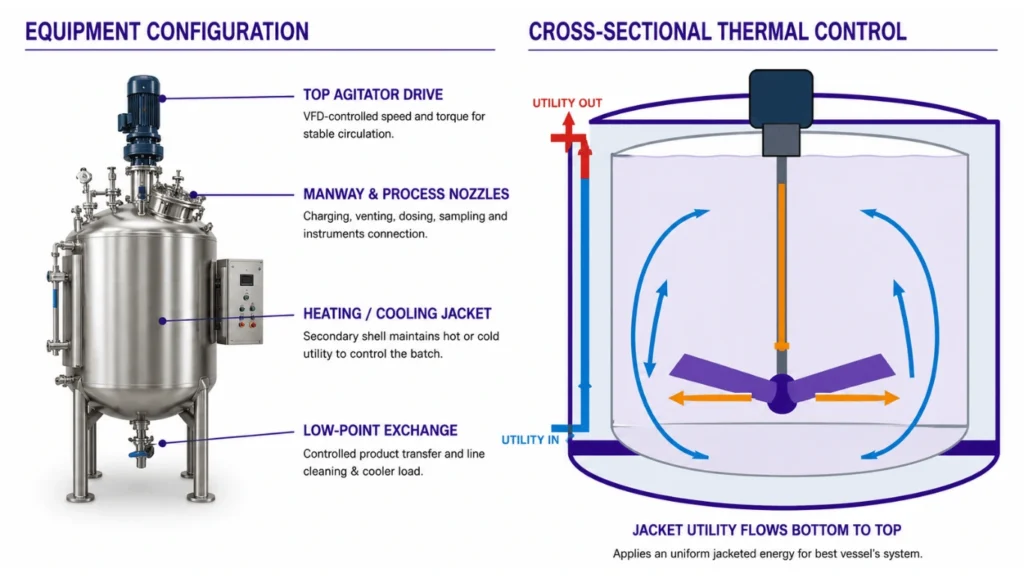
AGITATED THERMAL CONTROL
Agitation circulates the batch across the vessel wall while heating or cooling utility enters the lower jacket connection, rises through the jacket and exits from the upper connection. Temperature control adjusts utility flow against the batch profile.
CONTROLLED BATCH SEQUENCE
PREPARE
Venfy cleanliness, closures, utilities, venting, instruments and drive readiness.
CHARGE
Add ingredients under approved order, rate. level and vessel conditions.
AGITATE
Start under VFD control and establish stable batch circulation.
HEAT/COOL
Enable utility and follow the selected temperature ramp or hold.
VERIFY
Confirm batch temperature, sample and defined endpoint before release.
DISCHARGE
Transfer, isolate utilities, depressurize if required, clean and drain
CONTROL, SAFETY & MAINTENANCE
Vessel permissives
Agitation and utility are enabled only with confirmed level, closure, vent and instrument status.
Jacket protection
Utility pressure, temperature, venting, drainage and thermal expansion are included in the design.
Temperature control
Batch and utility sensors, control valve and alarms manage ramp, hold and deviation conditions.
Pressure protection
Vessel and jacket relief or vacuum protection are selected independently for credible scenarios.
Mechanical integrity
Agitator, seal, supports, jacket, nozzles and welds are verified for operating and upset loads.
Cleaning and isolation
Product, utility and energy isolation plus CIP access and low-point drains support safe maintenance.
PRELIMINARY VESSEL & THERMAL GUIDE
This page supports early screening only. Final vessel and jacket design requires confirmed utility conditions, thermal load, pressure cases, mixing duty,
material compatibility, relief basis and applicable code.
|
MODEL CLASS
|
GROSS VOLUME
|
SCREENING WORKING VOLUME AT 70%
|
BATCH MASS AT 1.0 kg/L
|
MOTOR RANGE
|
JACKET BASIS
|
|---|---|---|---|---|---|
|
JRV-0100
|
100 L
|
70 L
|
70 kg
|
0.37-0.75 kW
|
Engineered
|
|
JRV-0250
|
250 L
|
175 L
|
175 kg
|
0.75-1.5 kW
|
Engineered
|
|
JRV-0500
|
500 L
|
350 L
|
350 kg
|
1.1-2.2 kW
|
Engineered
|
|
JRV-1000
|
1.000 L
|
700 L
|
700 kg
|
1.5-4.0 kW
|
Engineered
|
|
JRV-2000
|
2,000 L
|
1,400 L
|
1,400 kg
|
3.0-7.5 kW
|
Engineered
|
|
JRV-5000
|
5,000 L
|
3,500 L
|
3,500 kg
|
5.5-15 kW
|
Engineered
|
CORE PRELIMINARY CALCULATIONS
1. SENSIBLE HEAT LOAD
Q [kJ] = Batch mass [kg] x heat capacity [kJ/kg.K] x temperature change [K]
2. REQUIRED THERMAL DUTY
Duty [kW] = Total heat load [kJ]/available heating or cooling time [s]
3. HEAT-TRANSFER AREA
Area [m2] = Required duty [kW]/ (overallU [kW/m2.K] x LMTD [K])
4. AGITATOR TORQUE
Torque [N.m] = 9550 x motor power [kW]/agitator speed [rpm]
FINAL SELECTION CHECKS
Heat balance
Batch mass, heat capacity, phase or reaction load, losses and target time define required duty.
Utility conditions
Utility type, temperature, pressure, flow, fouling and condensate or return arrangement are confirmed.
Pressure cases
Vessel and jacket design pressure, vacuum, blocked-in, thermal expansion and relief cases are independent.
Mixing and transfer
Rheology, solids, impeller, speed, seal, outlet and minimum level are selected together.
Materials and code
Corrosion, temperature, finish, gasket, welding, NDT and applicable construction code are verified.
Controls and safety
Temperature cascade, high-high trip, pressure protection, interlocks and emergency response are defined.
FINAL ENGINEERING CHECK
Confirm bin drawing and mass
Define CV and sampling
Complete representative trial
Verify lift and rotating load
Agree FAT acceptancencriteria
Need the Right JACKETED TANK & REACTION VESSEL
for Your Process?
Our engineers will help you select, size and configure the ideal system for your application.
Download Product Brochure
Fill in your details below to download the brochure.